|
|
Dello
stesso viaggio potete leggere anche:
|
The
AMERICAN ALPINE JOURNAL
1999, Editor Christian Beckwith, by The AMERICAN ALPINE CLUB.
Ortochasma Valley, Exploration, and Ascents in the
Karavshin.
pages 409-410
On our latest climbing trips we have always tried
to visit unpublished
sites. This comes with the high risk of making a deep  blunder.
This year our attention was hooked by an unknown valley between the
weel-known
Karavshin and Laylyak regions of the Pamir Alai. We (Paolo Vitali,
Sonja
Brambati and Eraldo Meraldi) had an excellent first contact with
locals,
hearty and expansive people who opened up their houses to us and as
they
would to friends. With these good beginnings, we started our trip in
the
Laylyak Valley, then crossed the Aktubek Pass (4300 m) to reach our
objective:
the Ortochasma Valley. Unfortunately, we were unlucky - we found no
granite
there at all there, only pudding-stones and loose rocks. After our
initial
disappointment, we had to make a demanding decision: go back? Do a trek
only? What else could we do? Consulting the cyrillic map with Ranger,
our
best horse driver, we understood that with two additional long walking
days we could reach the Karavshin region, where the granite is certain.
After ten hours' walking for five days, we finally reached the nice
grassy
Karavshin base camp. Lots of great routes have alredy been climbed here
by Russian and western climbers, but still a lot remains to be done.
For
the second time in a few days we had to change our goals to meet the
actual
conditions: maybe because of El Nino, this year the weather of the
range
wasn't exactly the "clean blue sky" for which it's famous. The rain
came
every day. So, instead of new big-wall routes, we spent our time
climbing
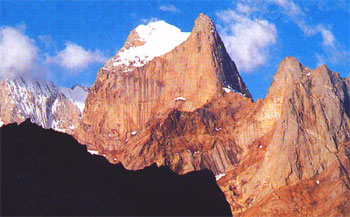
enjoyable shorter routes close to the base camp. On the lower section
of
the Russian Tower, we followed a nice crack system that we christend
"The
Missing Mountain" (580m F6a/b), while on the lower section of the
Central
Pyramid we first climbed the slabby "A Better World" (380m F6a/b with
one
pitch of F6c), and then the mixed "Take It Easy" (360m F7a). All of
them
are excellent free climbs on red granite with knobs and chicken heads;
the difficulties are mostly obligatory. We looked very carefully for
any
signs of preceding ascents during our climbs, but we found nothing.
Regarding
The Missing Mountain, we know of a route to the left of it, more in the
center of the wall, just right of the white rockfall scar, that we
joined
in the penultimate pitch. We found one piton on that pitch, the only
sign
we could find. We will surely remember the ascents from this trip as
much
as the wonderful time spent with Artyk, our guide-cook, and our
horseman
and their families, who gave us a great lesson in kindness and
humanity. blunder.
This year our attention was hooked by an unknown valley between the
weel-known
Karavshin and Laylyak regions of the Pamir Alai. We (Paolo Vitali,
Sonja
Brambati and Eraldo Meraldi) had an excellent first contact with
locals,
hearty and expansive people who opened up their houses to us and as
they
would to friends. With these good beginnings, we started our trip in
the
Laylyak Valley, then crossed the Aktubek Pass (4300 m) to reach our
objective:
the Ortochasma Valley. Unfortunately, we were unlucky - we found no
granite
there at all there, only pudding-stones and loose rocks. After our
initial
disappointment, we had to make a demanding decision: go back? Do a trek
only? What else could we do? Consulting the cyrillic map with Ranger,
our
best horse driver, we understood that with two additional long walking
days we could reach the Karavshin region, where the granite is certain.
After ten hours' walking for five days, we finally reached the nice
grassy
Karavshin base camp. Lots of great routes have alredy been climbed here
by Russian and western climbers, but still a lot remains to be done.
For
the second time in a few days we had to change our goals to meet the
actual
conditions: maybe because of El Nino, this year the weather of the
range
wasn't exactly the "clean blue sky" for which it's famous. The rain
came
every day. So, instead of new big-wall routes, we spent our time
climbing
enjoyable shorter routes close to the base camp. On the lower section
of
the Russian Tower, we followed a nice crack system that we christend
"The
Missing Mountain" (580m F6a/b), while on the lower section of the
Central
Pyramid we first climbed the slabby "A Better World" (380m F6a/b with
one
pitch of F6c), and then the mixed "Take It Easy" (360m F7a). All of
them
are excellent free climbs on red granite with knobs and chicken heads;
the difficulties are mostly obligatory. We looked very carefully for
any
signs of preceding ascents during our climbs, but we found nothing.
Regarding
The Missing Mountain, we know of a route to the left of it, more in the
center of the wall, just right of the white rockfall scar, that we
joined
in the penultimate pitch. We found one piton on that pitch, the only
sign
we could find. We will surely remember the ascents from this trip as
much
as the wonderful time spent with Artyk, our guide-cook, and our
horseman
and their families, who gave us a great lesson in kindness and
humanity.
Paolo Vitali, Italy.
|